
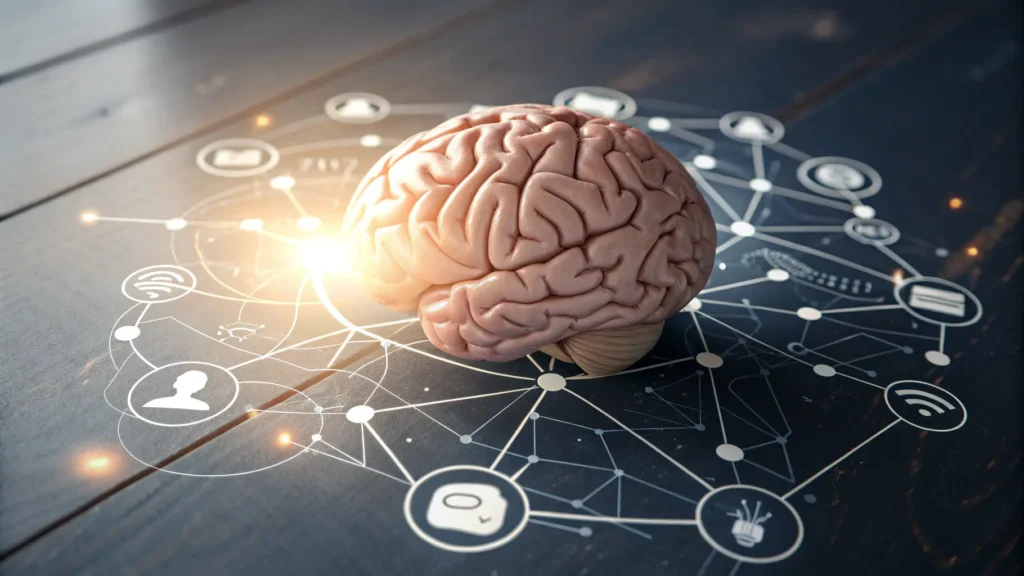
Ancient Instincts in
Modern Life
First, we will decode the deep biological legacy of our survival brain. Then, we will explore its real impact on everyday modern experiences.
Understanding the Ancient Operating System
To begin with, why does a vague financial worry or the judgment of a stranger cause your heart to race? Clearly, the answer does not lie in a personality flaw. Instead, it lies deeply embedded in your brain's ancient design.
Specifically, inside your skull is a powerful command center. Historically, it was formed by thousands of years of survival in a wild environment. Therefore, this is your evolutionary inheritance: ancient instincts designed to keep you alive, not necessarily calm.
Furthermore, these instincts operate on a very different timeline than modern logic. Indeed, they are automatic, emotionally intense, and immediate. As a result, they execute their programs before your logical mind even processes the data.
For example, you tense up before you can choose. Similarly, you panic before you can analyze. Ultimately, understanding this biological distinction is the absolute first step toward reclaiming your focus.
The Core Conflict: Evolutionary Mismatch
Currently, your brain is operating with biological hardware that hasn't received a real update in 50,000 years. However, it is navigating a world that updates every single second. Consequently, this massive evolutionary mismatch is the primary driver of chronic anxiety.
In fact, the system that was perfectly tuned for physical danger is now constantly overwhelmed by psychological stress. Therefore, test this difference visually below:
The System Works Perfectly
Primarily, stress is acute, intense, and cleared by physical action.
The System Misfires
Unfortunately, stress is chronic, low-level, and has no physical release.
The Modern Dopamine Hijack: The Hunt Never Ends
In our ancestral past, the chemical Dopamine was the biological reward system. Specifically, it motivated us to hunt, gather resources, and seek mates. Thus, it drove us to act when resources were scarce.
Consequently, in a world of abundance, this exact same instinct has been hijacked by modern technology. For instance, the variable rewards of social media act like ancient scarcity triggers. As a result, your brain thinks it is gathering vital resources, but it is actually caught in an exhausting loop.
Because of this, the constant pursuit creates an acute Dopamine deficit. Ultimately, this leads to deep fatigue, decision fog, and a lower ability to focus.
Generalized Misfires: When Ancient Logic Faces Life
To master your automatic reactions, you must first recognize their deep evolutionary logic. Moreover, we must look beyond specific contexts to understand that these stressors are everywhere. Here are the common ways your ancient software misinterprets daily data:
A Looming, Abstract Pressure
Ancient Root: Tangible PredatorFor this reason, your heart instantly races when facing an uncertain future. Your brain converts psychological uncertainty into a literal fight-or-flight emergency.
Fear of Social Judgment
Ancient Root: Death by ExileSpecifically, you hesitate to share a thought publicly. Being rejected by your 'tribe' once meant certain death. Thus, your system equates judgment with physical harm.
Compulsive Shopping
Ancient Root: Resource GatheringSimilarly, variable sales trigger massive urges. Your primitive brain still assumes scarcity rules. Therefore, you are motivated to gather resources unnecessarily.
Chronic Uncertainty Fatigue
Ancient Root: Constant VigilanceBecause of this, constant news alerts keep you hyper-alert. Your ancient brain cannot safely distinguish a low-level alert from vital danger, leading to severe burnout.
The Science of Regulation: Manually Resetting
Clearly, we cannot simply "logic" our way out of stress while our body is flooded with cortisol. To fix this mismatch, we must use body-to-brain strategies. A primary mechanism for this is Polyvagal Theory, which identifies our biological "off switch".
Specifically, we need to activate the **Vagus Nerve**. This nerve manually tells the ancient brain: *"I am safe. You can stand down."* Consequently, this is done through strategies like slow, deep belly breathing, humming, or brief nature walks.
Vibe Check: Nervous System Balance
Indeed, you can use the Vagus Nerve to manually reset your brain's alarm.
Sympathetic System
Fight / Flight / Freeze
(Ancient Panic)
Parasympathetic System
Rest / Digest / Bond
(Modern Calm)
Visualize the Vagus Nerve manually activating your calm mode. Consequently, regular activation builds real resilience.
Rewiring With Intention: Leveraging Neuroplasticity
Importantly, this isn't just generic "positive thinking." Instead, it is actual nervous system regulation driven by Neuroplasticity. Basically, neuroplasticity is the brain's proven ability to form new neural pathways through repetition.
By practicing daily regulation, you clearly signal to your survival brain that it can relax. Naturally, this process is gradual but highly permanent. Ultimately, you cannot change your biology's past, but you can absolutely rewire its future.
Your Biological Toolkit at Mind Origins
Ultimately, our platform provides the proven tools to transition from automatic reaction to conscious reflection. Therefore, integrate deep learning with our interactive ecosystem:
Evidence-Based Insight
First, read detailed articles exploring concepts like dopamine loops and cognitive bias.
Start Reading →Cognitive Training
Next, test your processing speed and focus through our proprietary brain games.
Enter the Lab →Self-Awareness Assessments
Finally, utilize our interactive quizzes to measure your baseline and cognitive load.
Take the Quiz →Frequently Asked Questions
In summary, understand how our evolutionary past shapes our modern minds.
You Are Not Your Instincts
Ultimately, you don't have to obey—you can observe. Initiate your system update today.
Take Your Full Evolutionary Assessment✓ 100% Free • Science-Backed • No Credit Card Required
Scientific References
- LeDoux, J. E. (2019). The Deep History of Ourselves.
- Barrett, L. F. (2020). Seven and a Half Lessons About the Brain.
- Lembke, A. (2021). Dopamine Nation: Finding Balance.
- Porges, S. W. (2023). Modern Polyvagal Theory Applications.
- Hölzel, B. K. et al. (2011/2023). Long-term neuroimaging studies.